

Redundancy sounds simple on paper: the role isn’t needed anymore, so the position goes. In practice, it’s one of the easiest processes to get legally wrong, and a redundancy that isn’t handled properly can turn into an unfair dismissal claim fast.
Employers often assume that because there’s a business reason behind the decision, they’re automatically protected, but the reason is only half the equation. Here’s what a genuine redundancy process requires, what it costs, and where employers tend to slip up.
What is the Redundancy Process In Australia?
The genuine redundancy process under the Fair Work Act means the employer no longer needs anyone to do the job, due to changes in operational requirements. It’s a defence against an unfair dismissal claim, but only if it’s done properly.
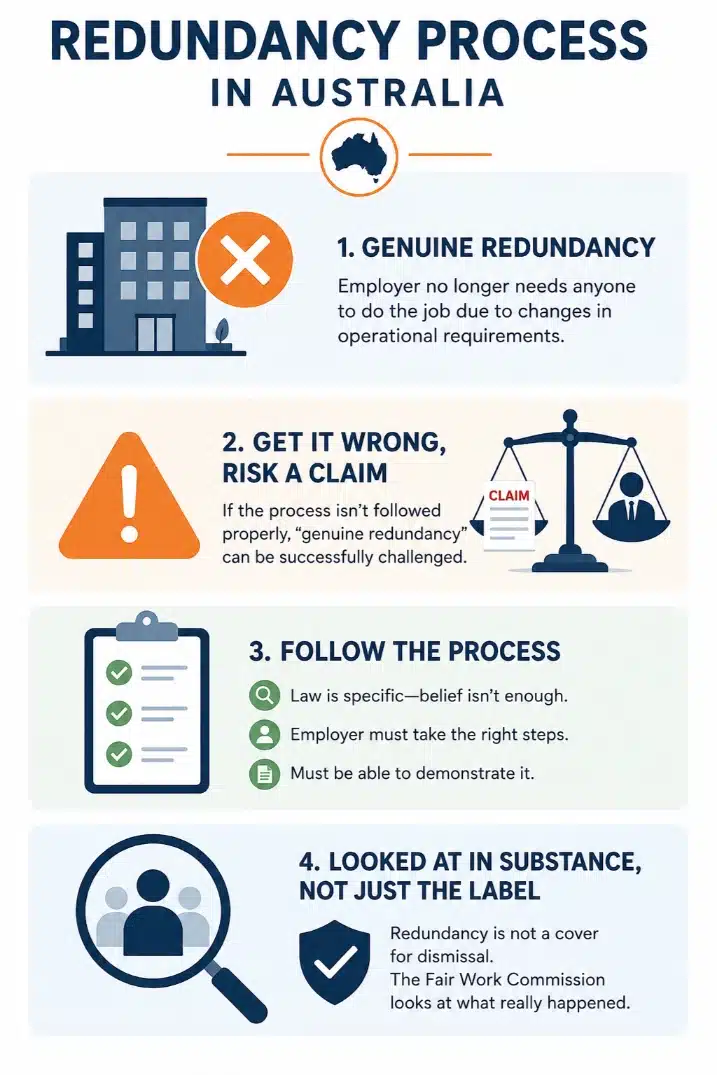
Get the process wrong, and “genuine redundancy” can quickly become something an employee successfully challenges. The law is deliberately specific, so it’s not enough to simply believe the redundancy is real. The employer has to be able to demonstrate it through the steps they actually took.
It’s worth understanding why the law is built this way. Redundancy removes an employee’s job through no fault of their own, so the framework exists to stop employers using “restructure” as a convenient label for what’s really a dismissal in disguise. That’s why the Fair Work Commission looks past the label and examines the substance of what actually happened.
Genuine vs non-genuine redundancy
The distinction is straightforward but often overlooked.
A genuine redundancy fits legal requirements when the role itself disappears, consultation obligations are met, and redeployment was properly considered. It’s not if the same role is simply advertised again under a new title, if consultation didn’t happen, or if a reasonable redeployment option existed and was ignored.
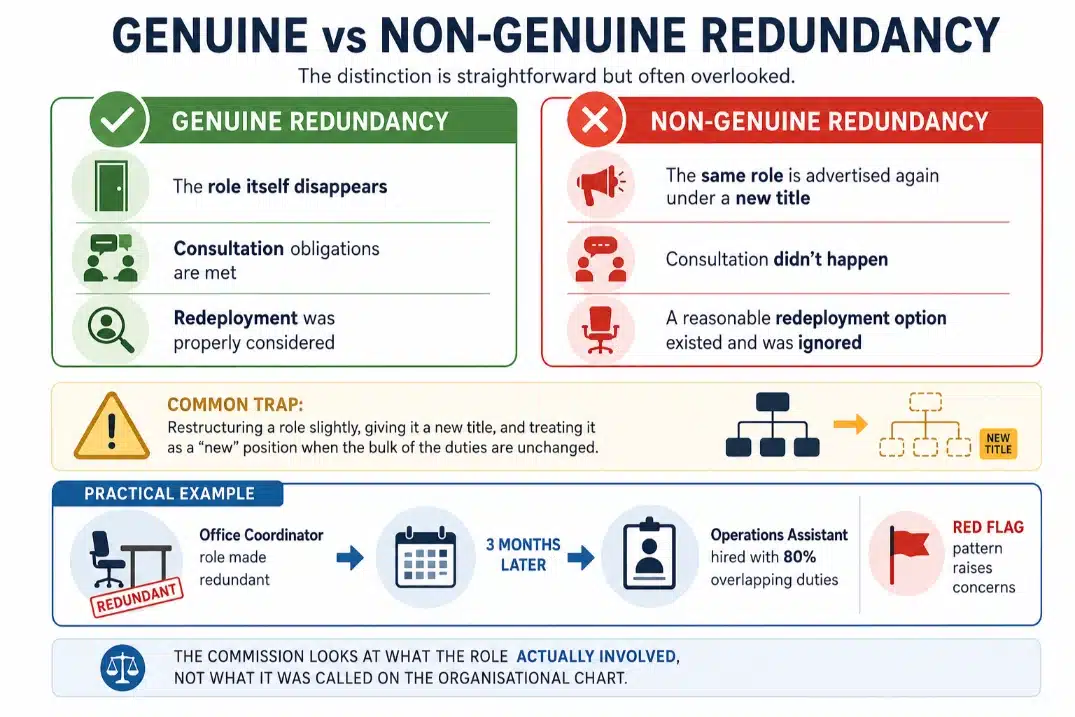
A common trap is restructuring a role slightly, giving it a new title, and treating it as a “new” position when in reality the bulk of the duties are unchanged. This kind of restructuring rarely holds up if challenged.
A practical example: if a business makes an “Office Coordinator” role redundant, then hires an “Operations Assistant” three months later with 80% overlapping duties, that pattern raises red flags. The Commission will look at what the role actually involved, not what it was called on the organisational chart.
This is why redundancy decisions need to be tested carefully much like other employer obligations around workplace bullying and harassment prevention or avoiding discrimination in employment decisions, a defensible process on paper isn’t enough if the substance doesn’t hold up to scrutiny
When is a Role Redundant?
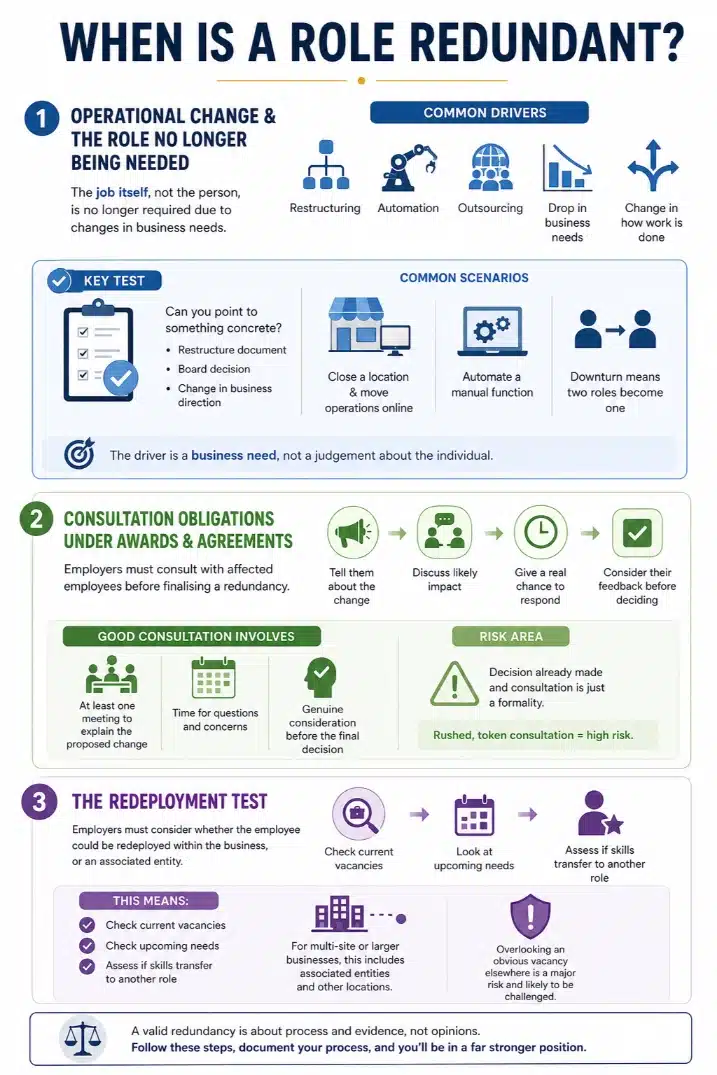
Operational change and the role no longer being needed
This usually comes down to restructuring, automation, outsourcing, a drop in business needs, or a change in how the work gets done.
The key test is whether the job itself, not the person, is no longer required. It helps to be able to point to something concrete, such as a restructure document, a board decision or a change in business direction, rather than relying on a general sense that the role isn’t needed anymore.
Common scenarios include a business closing a physical location and moving operations online, a company automating a manual data entry function, or a downturn in client work meaning two roles need to become one. In each case, the driver is a business need, not a judgement about the individual currently in the role.
Consultation obligations under awards and agreements
Most modern awards and enterprise agreements require employers to consult with affected employees before a redundancy is finalised.
That means telling them about the change, discussing its likely impact, and giving them a real chance to respond, not just informing them after the decision’s already locked in. Consultation should happen early enough that the outcome isn’t a foregone conclusion. If the decision’s already been made and consultation is just a formality, that’s a risk area.
Good consultation usually involves at least one meeting where the proposed change is explained, time given for the employee to ask questions or raise concerns, and a real consideration of anything they raise before the final decision is made. Rushing this into a single five-minute conversation is a common way employers undermine an otherwise solid case.
The redeployment test
Before terminating on redundancy grounds, employers need to consider whether the employee could be redeployed elsewhere in the business, or an associated entity.
Skipping this step is one of the fastest ways a redundancy gets challenged. This doesn’t mean creating a role that doesn’t exist, but it does mean checking current vacancies, upcoming needs, and whether the employee’s skills reasonably transfer to another position.
For larger or multi-site businesses, this test carries extra weight, since “the business” can extend to associated entities and other locations, not just the one site the role sat in. A redundancy that overlooks an obvious vacancy in another branch is far more likely to be challenged successfully.
How Does the Australian Redundancy Process Work?
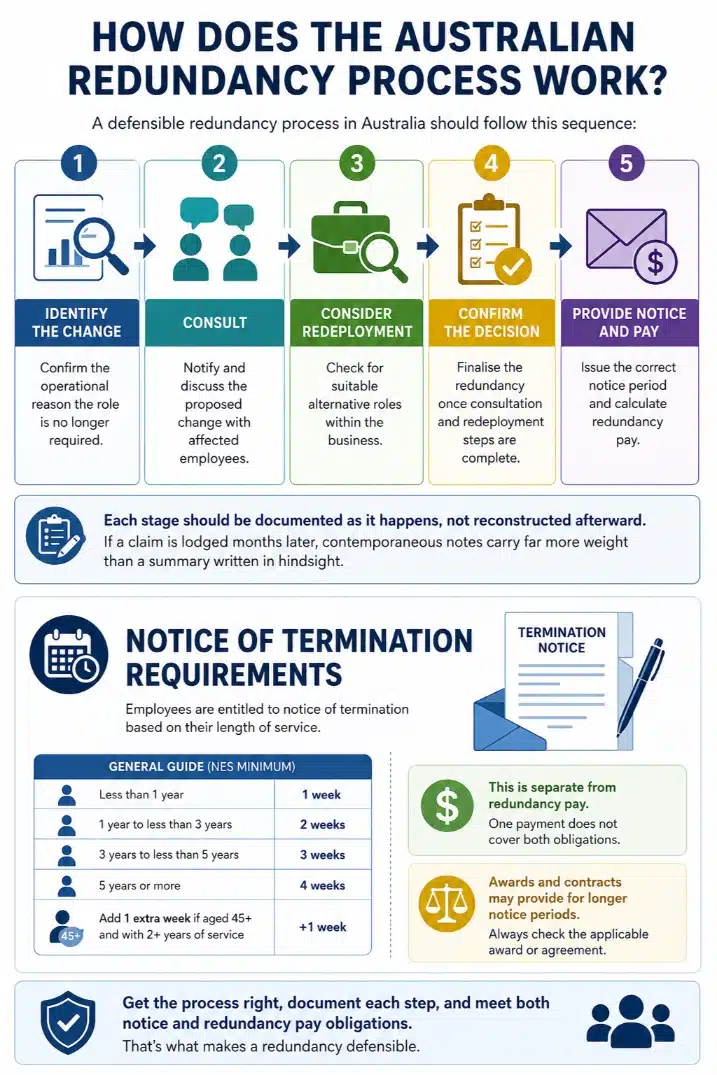
A defensible redundancy process in Australia should follow this sequence:
| Stage | What Happens |
| Identify the change | Confirm the operational reason the role is no longer required |
| Consult | Notify and discuss the proposed change with affected employees |
| Consider redeployment | Check for suitable alternative roles within the business |
| Confirm the decision | Finalise the redundancy once consultation and redeployment steps are complete |
| Provide notice and pay | Issue the correct notice period and calculate redundancy pay |
Each stage should be documented as it happens, not reconstructed afterward. If a claim is lodged months later, contemporaneous notes carry far more weight than a summary written in hindsight.
Notice of termination requirements
Employees are entitled to notice of termination based on their length of service, generally ranging from one to four weeks, with an extra week if the employee is over 45 and has completed at least two years of service.
This is separate from redundancy pay, and it’s a distinction that catches out employers who assume one payment covers both obligations.
Some awards and contracts specify longer notice periods, so it’s worth checking the applicable instrument rather than defaulting to the NES minimum.
How Much is Redundancy Pay?
Redundancy pay under the National Employment Standards (NES) is based on the employee’s continuous service, and it scales up the longer someone’s been with you – from nothing under 12 months of service through to 12 weeks’ pay after 9 or more years of service. Interestingly, it actually drops slightly after 10 years, so it’s worth checking the NES table directly for the exact entitlement.
Getting this calculation wrong, even unintentionally, is one of the more common compliance issues employers run into during a redundancy.
What’s included when calculating redundancy pay?
Redundancy pay is calculated based on the employee’s base rate of pay for their ordinary hours, and it doesn’t typically include things like overtime, bonuses, or allowances unless the award or agreement says otherwise. It’s worth checking the specific award, because some industries build in slightly different rules around what counts toward the base rate.
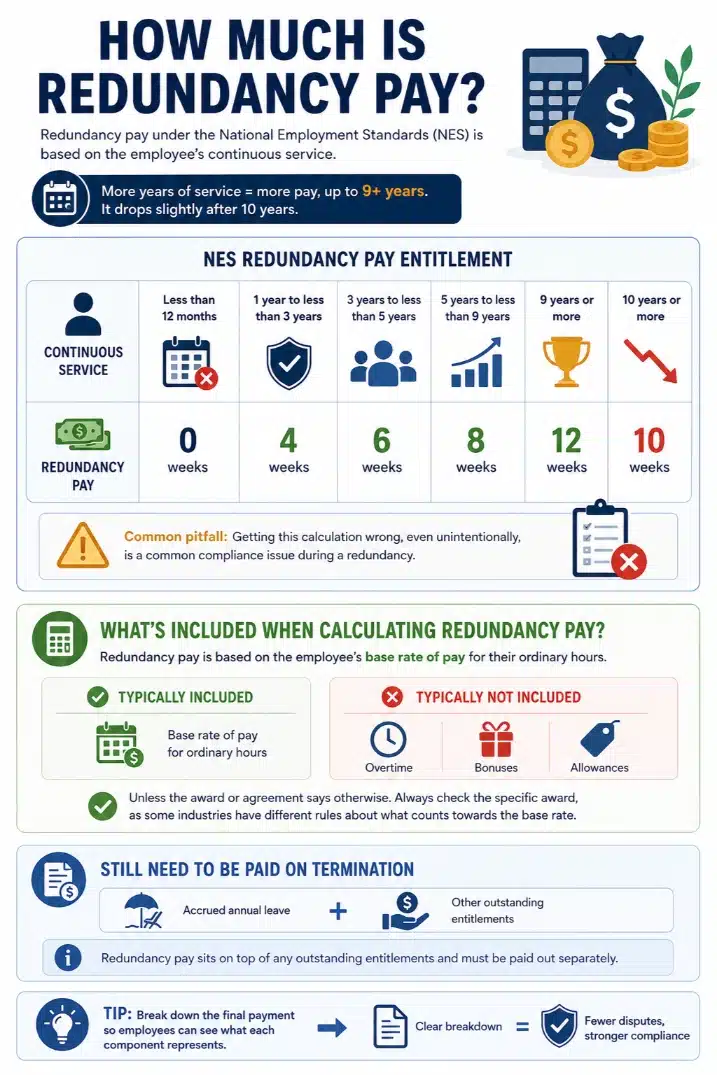
It’s also worth remembering that redundancy pay sits on top of any outstanding entitlements, like accrued annual leave, which still need to be paid out separately on termination. Employers sometimes bundle everything into one lump figure without breaking down what each component represents, which can create confusion (and disputes) down the track.

Which Employers and Employees are Exempt from Redundancy Pay?
Not every redundancy triggers a redundancy payment, and this trips up plenty of employers who assume it always applies.
The small business redundancy exemption
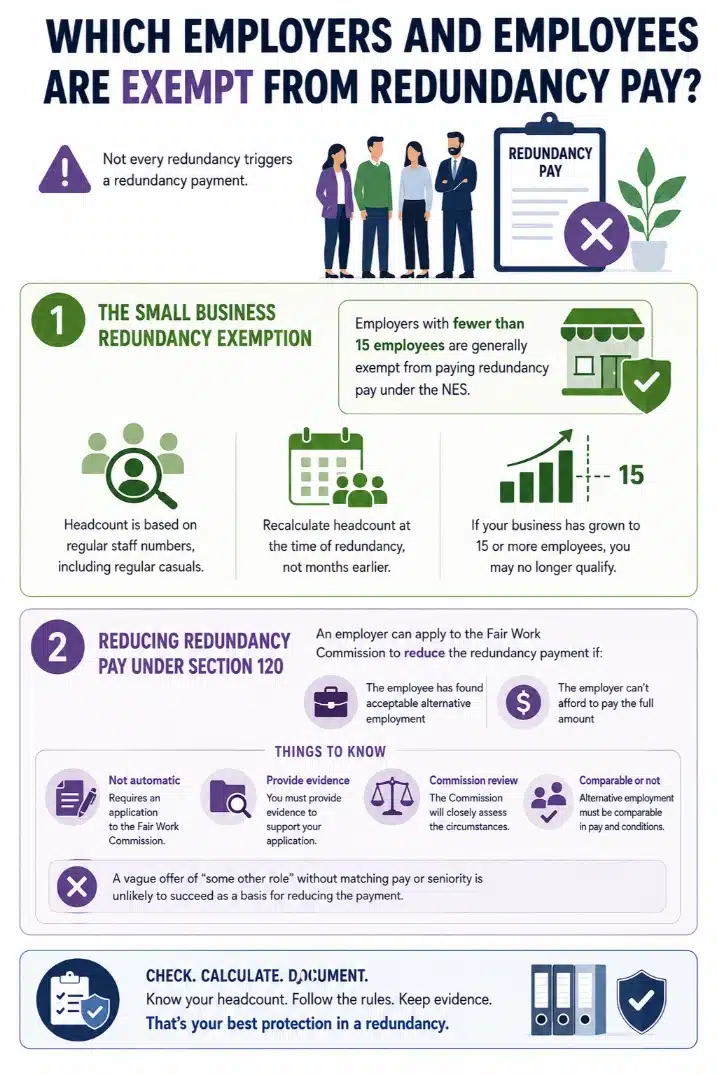
Employers with fewer than 15 employees are generally exempt from paying redundancy pay under the NES.
Headcount is based on regular staff numbers, including regular casuals, so it’s worth double-checking where your business actually sits before assuming the exemption applies. Businesses sitting right around the 15-employee mark should recalculate headcount at the time of the redundancy, not based on numbers from months earlier, since a business that’s grown past the threshold since the last check may no longer qualify.
Reducing redundancy pay under section 120
Even outside the small business exemption, an employer can apply to the Fair Work Commission to reduce the redundancy payment if they’ve found the employee acceptable alternative employment, or if they can’t afford to pay the full amount.
This isn’t automatic. It requires an application and evidence, and the Commission will look closely at whether the alternative employment offered is comparable in pay and conditions before agreeing to any reduction. A vague offer of “some other role” without matching pay or seniority is unlikely to succeed as a basis for reducing the payment.
What is the Employer Risk in a Redundancy?
The biggest risk in any redundancy isn’t the redundancy pay itself, it’s the process around it.
Skip consultation, ignore a redeployment option, or use redundancy as a way to remove an underperforming employee without the proper performance process, and you’re exposed. These claims often come down to whether the employer can produce records, meeting notes, correspondence, and documentation that back up the story they’re telling the Commission.
When redundancy becomes unfair dismissal
If an employee can show the redundancy wasn’t genuine, whether because the role wasn’t actually redundant, consultation didn’t happen, or redeployment wasn’t considered, the dismissal can be challenged as unfair.
This is one of the more common ways redundancies unravel, particularly when they’re used to manage an employee for reasons that have little to do with the role itself. Employers sometimes reach for redundancy because it feels like a cleaner exit than a formal performance process, but if the underlying motivation surfaces during a claim, it can undo the entire defence.
A useful way to think about this: if the real reason for letting someone go is their performance, attitude, or conduct, redundancy is the wrong tool entirely. Using it as a shortcut around a proper performance management process is one of the most common (and most costly) mistakes employers make, because it tends to surface exactly when it matters most, during a claim.
Redundancy vs Other Types of Termination
It helps to understand where redundancy sits relative to other ways employment can end, since confusing them is a common source of process errors.
| Termination type | Driven by | Requires performance process? | Requires redundancy pay? |
| Genuine redundancy | The role no longer exists | No | Generally yes (unless exempt) |
| Performance-based dismissal | The employee’s capacity or conduct | Yes | No |
| Resignation | The employee’s choice | No | No |
| Mutual termination | Agreement between both parties | No | Depends on agreement terms |
Mixing these up, for example, dismissing someone for performance reasons but labelling it a redundancy to avoid a difficult conversation, is one of the fastest ways to end up defending a claim you didn’t need to have.
How Can Employers Reduce Redundancy Risk?
A well-documented genuine redundancy process is your best protection, and it comes down to a few consistent habits:
• Confirm the operational reason clearly, and be able to explain it if challenged.
• Follow consultation requirements under the relevant award or agreement, every time.
• Properly assess redeployment options before finalising anything.
• Calculate notice and redundancy pay correctly, checking service length and any applicable exemptions.
• Keep records of consultation, decisions, and reasoning throughout.
• Get advice early, particularly if there’s any risk the redundancy could be seen as targeting a specific individual.
The Genuine Redundancy Requirements to Follow
Getting this right takes more than good intentions. It takes people who deal with this process regularly.
Our HR consulting services can help you scope a redundancy properly before you start the conversation with affected staff, and if redundancy is part of a bigger restructure, HR outsourcing services can support you through the whole process rather than just the final step.
And if you just need a fast, referenced answer on a specific redundancy question, our HR advice hotline is built exactly for that.
Redundancy done properly protects your business and treats your people fairly. Done poorly, it’s one of the quickest paths to a costly claim, so it’s worth getting the process right from the very first conversation.
Frequently Asked Questions
Do casual employees get redundancy pay?
Generally, only regular casuals count toward headcount for the small business exemption, and casual employees typically aren’t entitled to redundancy pay under the NES in the same way permanent employees are, though this can vary depending on the specific award or agreement.
Can an employee refuse redeployment and still get redundancy pay?
If a suitable alternative role is offered and refused without good reason, this can affect the outcome, so it’s worth documenting the offer and the employee’s response clearly.
Does redundancy pay apply to fixed-term contracts?
Generally, redundancy pay doesn’t apply where employment ends simply because a fixed-term contract has run its course, since this isn’t considered a redundancy under the NES.
What happens if we get the redundancy pay calculation wrong?
An underpayment can be pursued separately from any unfair dismissal claim, so it’s worth double-checking the calculation against the NES scale and the applicable award before finalising anything.

Cedric has 13+ years of demonstrated experience as a senior HR generalist with a broad commercial and project-driven background within leading global organisations across a range of industries. He is qualified with an MBA from the Australian Institute of Business (AIB), an Advanced Diploma of Management specialising in Human Resources and an HR Consulting – Business Partnering course from the Australian Human Resources Institute (AHRI).