

Most employers know bullying and harassment are wrong, but could they recognise every form it can take? Or confidently say their current systems could hold up if a formal complaint landed on their desk tomorrow?
This guide from HR Expertise walks through what Australian workplace bullying looks like under the law, the duties employers carry, and practical ways to prevent it before it becomes a problem, along with what to do if a report does land on your desk.
What is Workplace Harassment and Bullying?
Workplace bullying is repeated, unreasonable behaviour directed at a worker or group of workers that creates a risk to their health and safety.
Two things need to be present for behaviour to count as bullying: it has to happen more than once (a single bad interaction isn’t bullying, though it shouldn’t be ignored either), and it has to be unreasonable, the kind of behaviour a reasonable person looking at the situation would agree crosses the line.
Workplace harassment can take many forms, and it isn’t always loud or obvious.
- Belittling comments
- Deliberately excluding someone from meetings or information they need to do their job
- Spreading rumours
- Setting impossible deadlines on purpose,
- Constantly changing someone’s responsibilities to set them up to fail can all count, even when none of it looks like a single dramatic incident.
Bullying can also travel in more than one direction. It’s most commonly thought of as downward, from a manager to a worker, but it can just as easily happen sideways between colleagues, or even upwards from a group of workers toward a supervisor.
It can also come from outside the immediate team entirely, from clients, customers, or members of the public that staff interact with, and employers still carry responsibility for managing that risk where it’s reasonably practicable to do so.
Bullying vs Reasonable Management Action
This is where employers sometimes hold back from managing performance because they are worried it’ll be seen as bullying. It won’t be, provided it’s handled properly.
Giving honest feedback, setting realistic performance goals, restructuring a team, or taking disciplinary action where it’s warranted are all legitimate exercises of management authority, and they are not bullying just because the employee involved finds them uncomfortable.
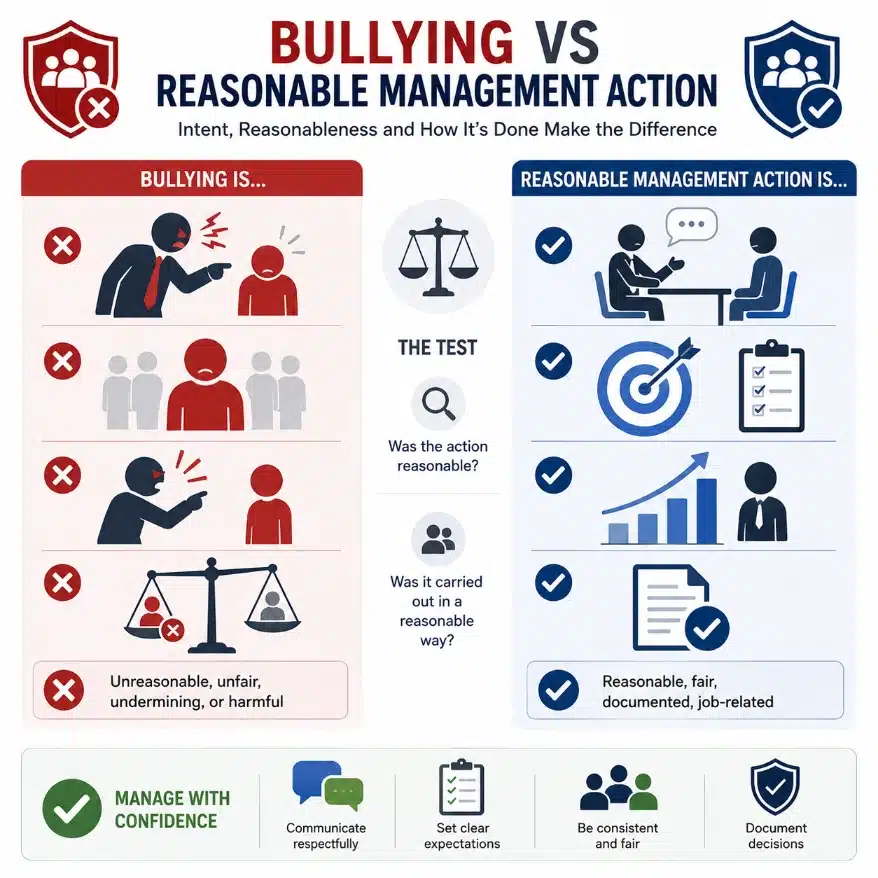
The real test isn’t how the employee feels about the action, it’s whether the action itself was reasonable and carried out in a reasonable way. A performance conversation delivered constructively and fairly is management doing its job.
The same conversation delivered aggressively, inconsistently, or without any basis starts to look very different. Courts and tribunals generally look at whether the management action itself was reasonable, and separately, whether it was carried out in a reasonable manner.
What Counts as Sexual Harassment?
Sexual harassment is unwelcome sexual conduct that a reasonable person would expect to make someone feel offended, humiliated, or intimidated. It doesn’t need to be physical. Unwanted comments, inappropriate jokes, persistent requests for a relationship after being turned down, or sharing explicit material can all meet the threshold.
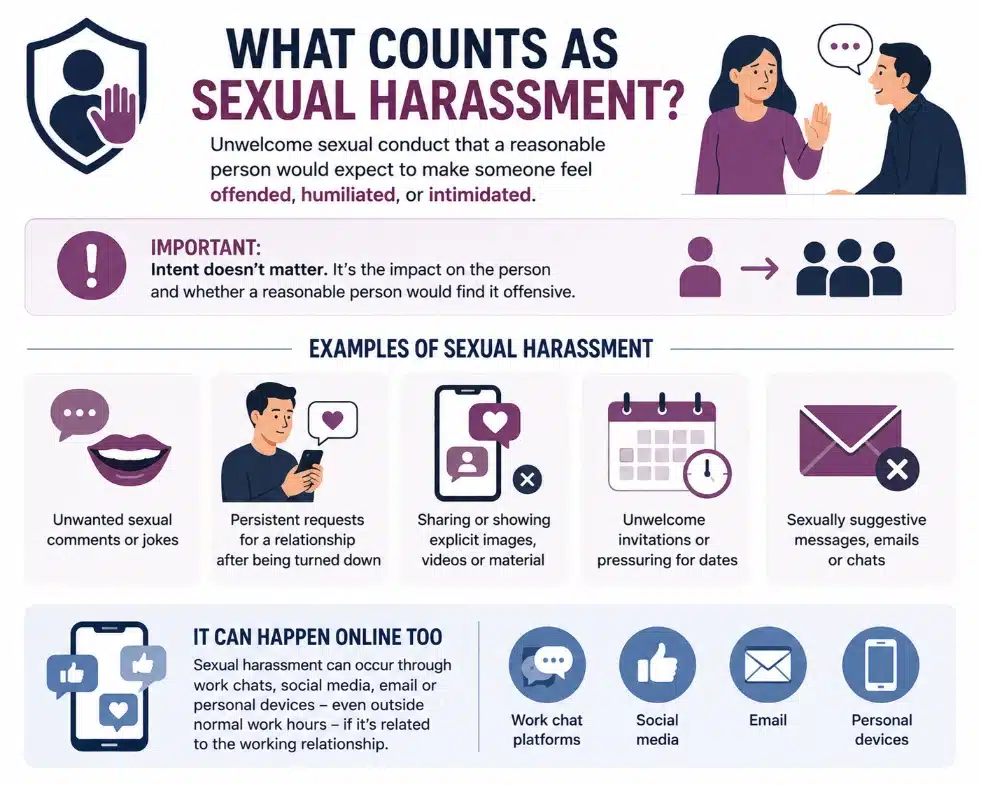
Importantly, intent isn’t the deciding factor. The impact on the person experiencing it and whether a reasonable person would find it offensive matters far more than what the person responsible claims they meant by it.
It’s also worth knowing that sexual harassment can occur through digital channels just as easily as in person, so inappropriate messages sent through work chat platforms, social media, or personal phones used to contact a colleague outside work hours can all fall within scope if they’re connected to the working relationship.
What Laws Create Employer Duties on Bullying and Harassment?
Several overlapping legal frameworks place duties on employers here, which is part of why this area needs more than a single policy to manage properly.
Fair Work Commission Stop Orders
Workers who reasonably believe they are being bullied at work can apply to the Fair Work Commission for an order to stop the bullying.
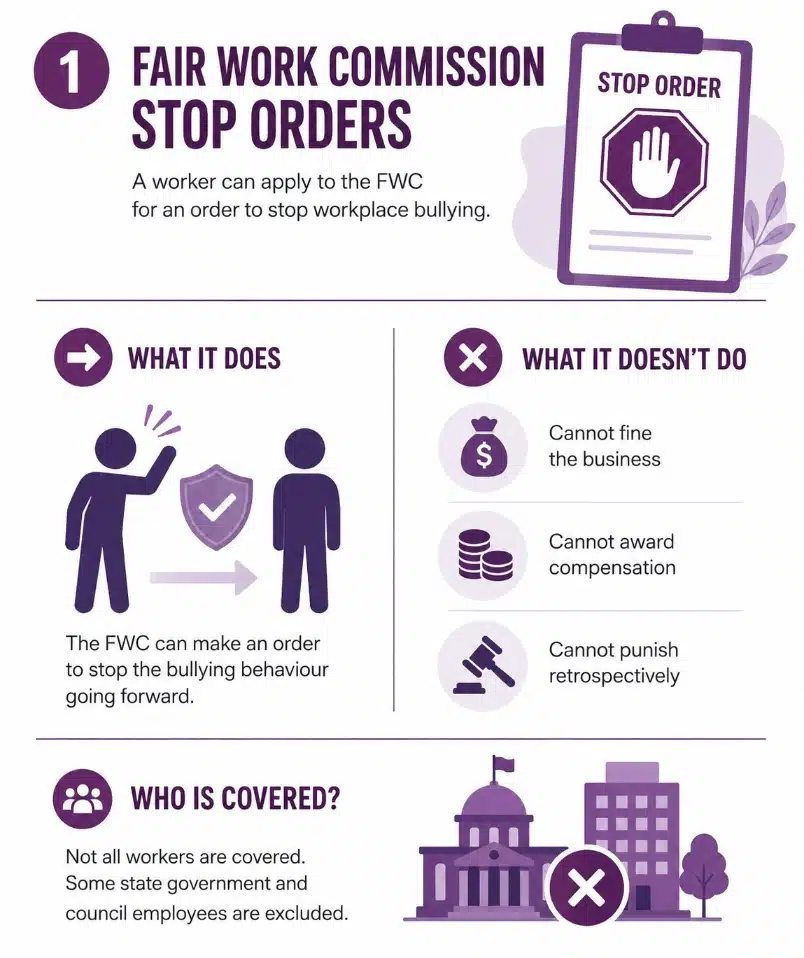
It’s worth understanding the limits of this jurisdiction though, the Commission’s anti-bullying powers are specifically about stopping the behaviour going forward. It can’t issue fines, order compensation, or punish the business retrospectively. Its focus is entirely on resolving the situation and restoring normal working relationships.
It’s also worth noting this jurisdiction doesn’t cover every Australian worker. Some employees of state government bodies and local councils fall outside its scope, so eligibility isn’t automatic and depends on the specific employment arrangement.
Work Health and Safety Duties and Psychosocial Hazards
Under work health and safety law, bullying is treated as a psychosocial hazard, a risk to psychological health in the same way a trip hazard is a risk to physical safety.
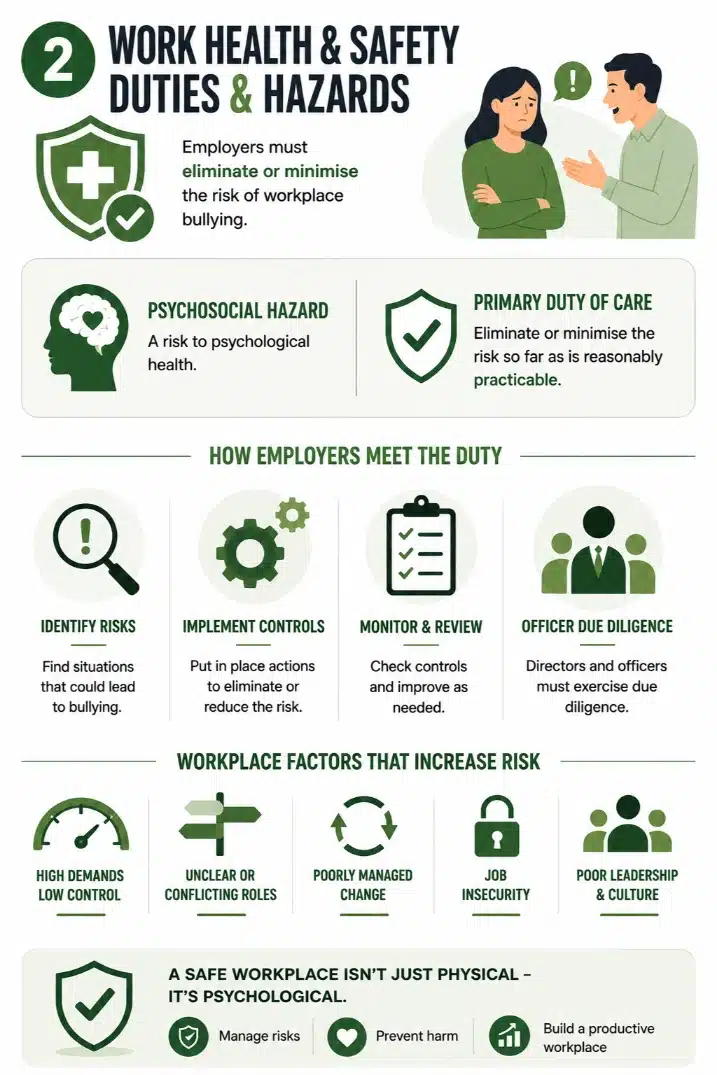
This means employers carry a primary duty of care to eliminate or minimise the risk of workplace bullying in Australia so far as is reasonably practicable, the same standard applied to any other workplace hazard.
This duty requires actively identifying situations likely to increase bullying risk (high-pressure environments, unclear roles, poor management practices), implementing controls, and monitoring whether those controls are working. Company officers, like directors, also carry a specific duty to exercise due diligence in making sure the business has the right resources and processes in place.
Certain workplace characteristics are consistently linked to higher psychosocial risk: high job demands combined with limited control over how work gets done, unclear or conflicting roles, poorly managed organisational change, and job insecurity all tend to increase the likelihood of bullying taking hold if left unaddressed.
Sexual Harassment and The Sex Discrimination Act
Sexual harassment sits under the Sex Discrimination Act as a distinct form of unlawful conduct, separate from general workplace harassment protections.
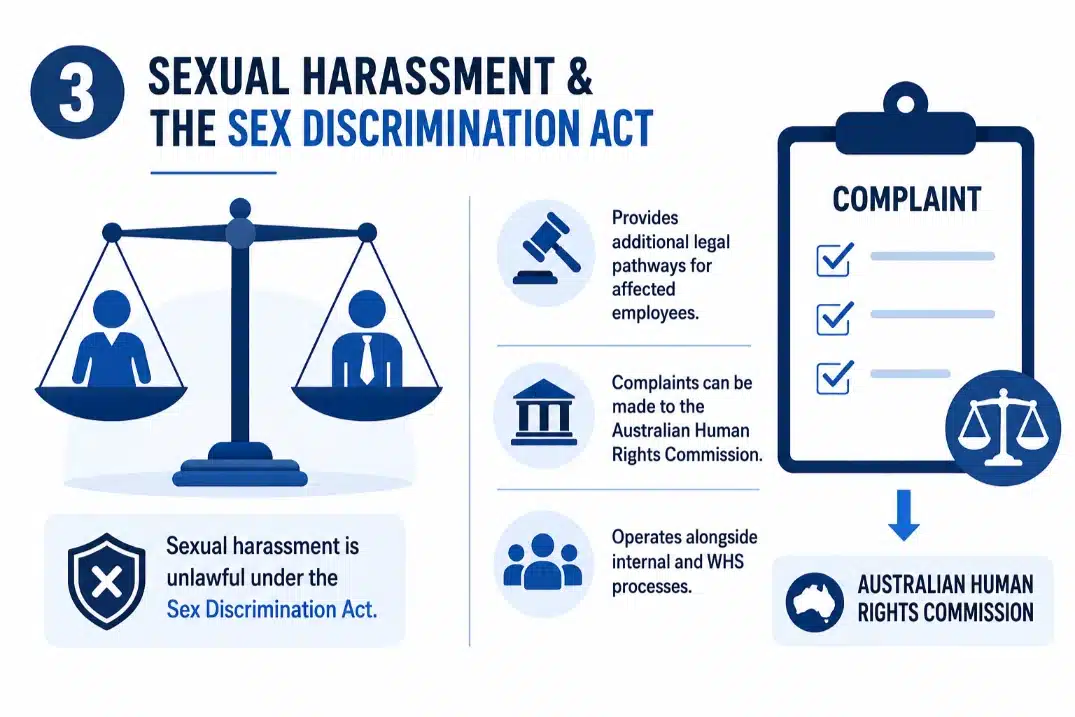
This matters because it opens up a different set of legal pathways for affected employees, including complaints to the Australian Human Rights Commission, alongside whatever internal or WHS-based process the employer runs.
What is the Employer’s Positive Duty to Prevent Workplace Bullying?
Similar to the shift we have seen in broader discrimination law, employers now carry a positive duty to proactively prevent sexual harassment and related conduct, not just respond after a complaint is made.
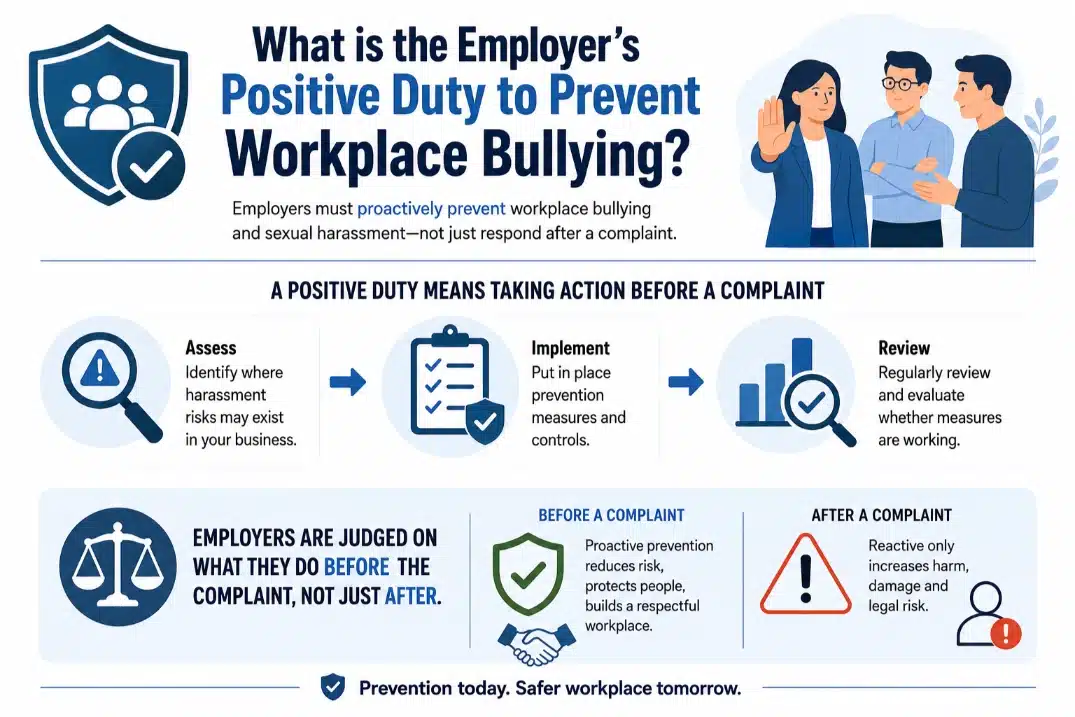
This means actively assessing where harassment risk might exist in your business, implementing prevention measures, and reviewing whether those measures are working, rather than relying on a policy nobody has looked at since it was written.
Workplace bullying prevention and harassment prevention increasingly sit under the same expectation: employers are judged not just on how they respond to a complaint, but on what they were doing before one was ever made.
What is the Employer Risk?
The risks here stretch across several categories at once. There’s the WHS risk, since a failure to manage psychosocial hazards can result in regulatory action and, in the most serious cases, prosecution.
There’s the Fair Work Commission risk, where a stop bullying order can be sought even without a resolved internal process. And there’s the broader risk to the business itself; high staff turnover, absenteeism, lost productivity, and reputational damage all tend to follow Australian workplaces where workplace bullying goes unaddressed.
There’s also a cost dimension that’s easy to underestimate. Worker’s compensation claims linked to psychological injury from bullying have become increasingly common and increasingly costly, and unlike many physical injury claims, psychological injury claims often involve longer recovery periods and higher overall costs to the business.
Vicarious Liability and the Reasonable Steps Defence
Just like in workplace discrimination cases, Employers can be held vicariously liable for harassment or bullying carried out by their employees, even where the business itself never directly participated in or was aware of the specific conduct.
The main way to defend against this is demonstrating that the business took reasonable steps to prevent the behaviour, which typically means having a policy, training that’s delivered (not just referenced in an induction pack), and a track record of taking complaints seriously when they arise.
This is exactly why workplace bullying prevention matters more than reaction. A business that can point to real, ongoing prevention efforts is in a fundamentally stronger position than one scrambling to demonstrate compliance after a complaint has already been lodged.

How Should Employers Respond When a Complaint is Made?
Having a strong prevention framework matters, but so does knowing how to respond properly once a report comes in, since a poorly handled response can undo months of good prevention work.
A sound response generally follows a consistent structure:
• Act promptly: Delayed responses tend to make situations worse and can signal to staff that complaints aren’t taken seriously.
• Gather the facts: before jumping to conclusions, speaking with the people involved and anyone who witnessed the behaviour.
• Apply procedural fairness throughout: meaning the person the complaint is about is told what’s alleged and given a chance to respond before any decision is made.
• Maintain confidentiality: as far as possible, limiting who knows the details to those directly involved in resolving the matter.
• Keep clear records of what was reported: when, what was done in response, and the outcome.
• Decide whether the matter can be resolved directly between the parties: or whether it needs a more formal investigation, which is usually the case for serious, complex, or disputed allegations.
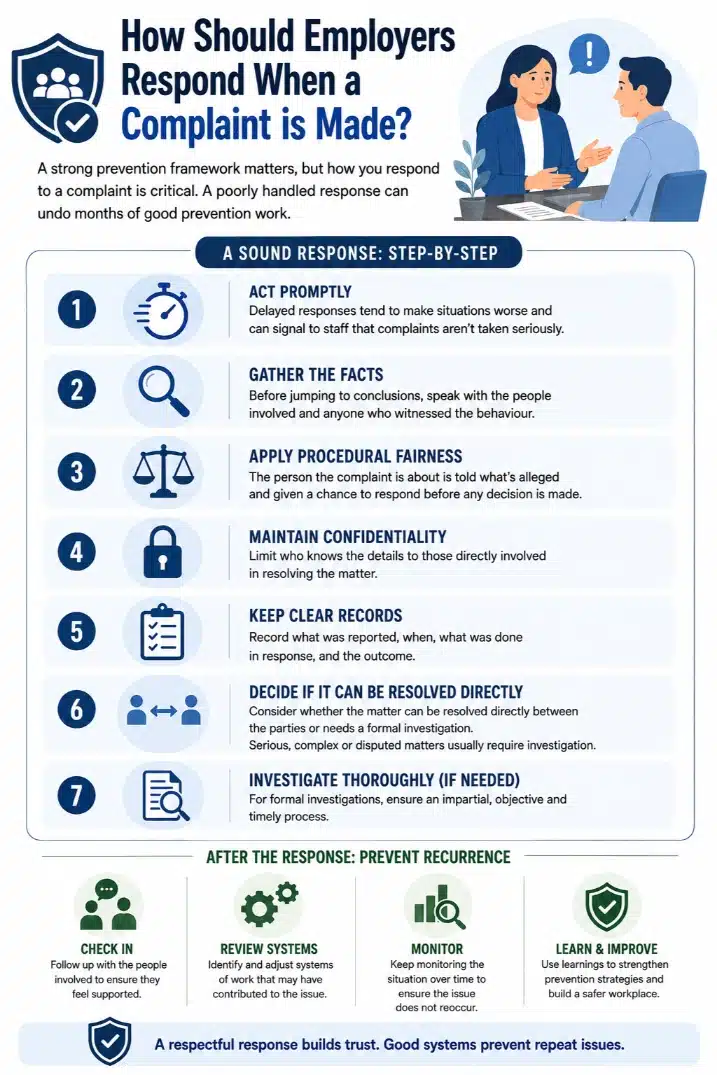
Checking in with the people involved, reviewing whether the systems of work that contributed to the issue need adjusting, and monitoring the situation over time all help prevent a recurrence.
How Can Employers Prevent Bullying and Harassment?
Effective workplace bullying prevention comes down to consistent effort rather than a single policy document.
Some of the most effective steps include:
• Setting clear standards of behaviour through a code of conduct or dedicated policy, developed with input from your team rather than handed down without consultation.
• Training managers and supervisors specifically, since poor leadership behaviour and unclear management practices are consistently linked to higher bullying risk.
• Building a reporting process that people trust, one where reports are taken seriously, handled promptly, and where the person reporting isn’t left wondering if anything will happen.
• Applying procedural fairness consistently when responding to any report, treating the accused as entitled to respond, keeping the process confidential where possible, and remaining neutral throughout.
• Reviewing systems of work regularly, since workload pressure, unclear roles, and poor communication are all recognised risk factors that can be addressed before they turn into bullying incidents.
• Monitoring for warning signs proactively, rising absenteeism, unusual staff turnover, or a spike in grievances can all indicate a problem developing before a formal complaint is ever made.
HR Support to Help Prevent Workplace Harassment
Getting this right takes more than good intentions. It can be difficult to build and monitor these systems without dedicated HR support.
Our human resources services can help you build a policy and reporting framework that holds up. If you would rather have this managed end to end, you might consider outsourcing your HR services so you’re not carrying the compliance burden alone.
And when a specific bullying or harassment question comes up that needs a fast, referenced answer, our HR advice hotline gives you that support on demand.
Preventing workplace bullying and harassment isn’t just about avoiding legal risk, though that risk is real and growing. It’s about building a workplace where people can do their best work without fear, and that starts with treating prevention as an ongoing responsibility rather than a box to tick once and forget.
Frequently Asked Questions
Does a single incident ever count as workplace harassment?
Generally no, bullying is characterised by repeated behaviour, but a single serious incident can still be a workplace issue requiring action, and repeated smaller incidents can escalate into bullying if left unaddressed.
Can an employer be liable for bullying by a client or customer?
Yes, where reasonably practicable, employers carry a duty to manage bullying risk from external parties too, which might mean setting behavioural expectations in contracts or empowering staff to end interactions that breach those standards.
What’s the difference between a WHS complaint and a Fair Work Commission stop bullying application?
A WHS complaint relates to the employer’s duty to manage the risk under safety law, while a Fair Work Commission application is a specific legal pathway an employee can use to seek an order stopping ongoing bullying. They are not mutually exclusive.
Is an anonymous reporting option required by law?
It’s not a strict legal requirement, but anonymous or confidential reporting channels are widely recognised as good practice and support early detection of issues before they escalate.

Cedric has 13+ years of demonstrated experience as a senior HR generalist with a broad commercial and project-driven background within leading global organisations across a range of industries. He is qualified with an MBA from the Australian Institute of Business (AIB), an Advanced Diploma of Management specialising in Human Resources and an HR Consulting – Business Partnering course from the Australian Human Resources Institute (AHRI).