

Workplace discrimination is one of those areas where good intentions aren’t enough. Plenty of employers who would never dream of treating someone unfairly still end up on the wrong side of workplace discrimination laws, usually because a policy, a hiring process, or an offhand comment created a problem nobody meant to cause.
This guide breaks down what discrimination actually looks like under Australian law, who’s protected, what employers need to do to stay compliant, and where the risk tends to hide in day-to-day decisions.
What is Workplace Discrimination Under Australian Law?
Workplace discrimination Australia-wide is treating someone unfavourably, or applying a rule that disadvantages them, because of a personal characteristic the law protects. It’s not limited to hiring decisions either. Discrimination can show up anywhere across the employment relationship, in recruitment, pay, promotions, training opportunities, rostering, and termination.
What trips a lot of employers up is that discrimination doesn’t need to be deliberate to be unlawful. A manager might believe they are applying a fair, neutral rule, and still end up disadvantaging a particular group of workers without realising it. This is exactly why workplace discrimination law looks at outcomes and impact just as closely as it looks at intent.
It’s also worth understanding that discrimination doesn’t need to be a single dramatic event to be significant. A pattern of smaller decisions, such as consistently being overlooked for promotion opportunities, excluded from meetings or training that other employees are invited to attend, denied access to career development opportunities available to comparable colleagues, or being treated differently in the application of workplace policies or disciplinary processes because of a protected attribute can collectively amount to discrimination, even where no single incident appears obviously unfair in isolation.
Direct vs Indirect Discrimination
Australian law splits discrimination into two categories, and understanding the difference matters because they show up in very different ways.
• Direct discrimination is the more obvious one: treating a person less favourably specifically because of a protected attribute. Refusing to hire someone because of their age, cutting a worker’s hours because of their religion, or passing someone over for a promotion because they are pregnant are all textbook examples.
• Indirect discrimination is subtler: happening when a rule or requirement applies to everyone equally on paper, but ends up disadvantaging people with a particular attribute in practice.
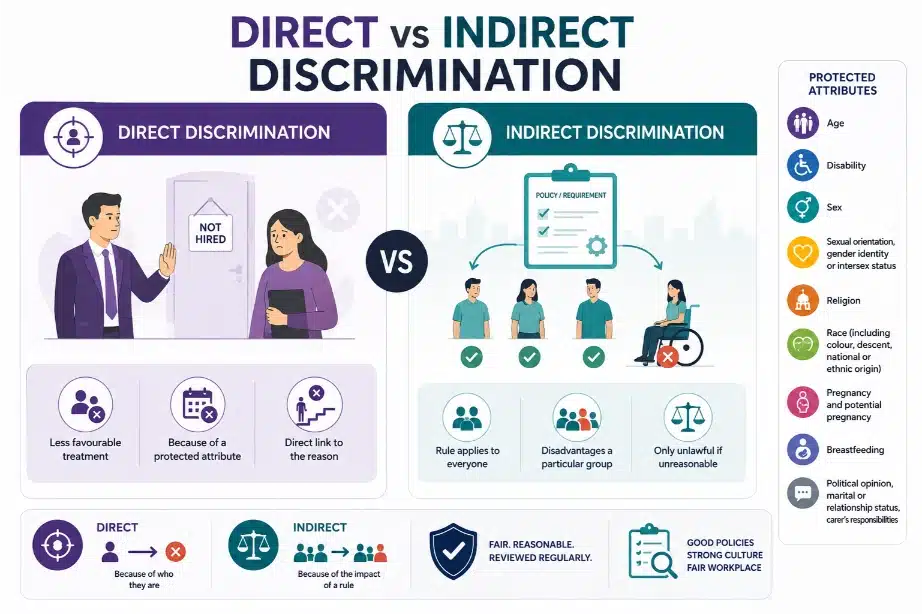
A workplace policy or requirement may appear neutral on its face but still have a discriminatory effect if it disproportionately disadvantages people with a protected attribute and isn’t reasonable in the circumstances. For example, requiring all applicants to meet a physical standard that isn’t genuinely necessary for the role, or imposing a workplace requirement that unnecessarily excludes employees with a protected attribute, may give rise to indirect discrimination. The key legal question is usually whether the requirement was reasonable in the circumstances, which we’ll come back to.
A useful way to think about the difference:
• Direct discrimination asks “was this person treated worse because of who they are?”
• Indirect discrimination asks “does this rule, even though it applies to everyone, end up negatively affecting a particular group, and is there a good reason for it?”
Employers often focus their compliance efforts entirely on avoiding direct discrimination, while indirect discrimination quietly sits in policies nobody has reviewed in years.
Which Laws Govern Workplace Discrimination?
There isn’t a single piece of legislation covering workplace discrimination compliance. Instead, it’s a patchwork of federal and state laws that all interact, which is part of why this area trips employers up so often.
The Fair Work Act General Protections
The Fair Work Act 2009 includes a set of general protections provisions that prohibit employers from taking adverse action against an employee because of a protected attribute or because they have exercised a workplace right. Adverse action covers a wide range of employer conduct, dismissal, demotion, altering someone’s position to their disadvantage, or refusing to employ someone in the first place due to a protected attribute.
What makes the general protections framework particularly significant for employers is how the burden of proof works, which we’ll unpack shortly, since it flips the usual rules. It’s also worth knowing that general protection claims aren’t limited to employees who have completed a minimum employment period, unlike unfair dismissal, which means the exposure exists from an employee’s very first day.
Federal Anti-Discrimination Acts and The AHRC
Alongside the Fair Work Act, several standalone federal laws deal specifically with discrimination on particular grounds:
• The Sex Discrimination Act 1984 covers discrimination based on sex, gender identity, sexual orientation, marital status, pregnancy, and family responsibilities.
• The Racial Discrimination Act 1975 prohibits discrimination based on race, colour, descent, and national or ethnic origin.
• The Disability Discrimination Act 1992 protects people with a disability from unfair treatment across employment and other areas of life.
• The Age Discrimination Act 2004 prohibits discrimination based on age, whether someone is considered too young or too old for a role.
The Australian Human Rights Commission Act 1986 establishes the AHRC itself, which investigates and helps resolve discrimination complaints, generally starting with conciliation before matters progress to the Federal Court or the Federal Circuit and Family Court if unresolved.
Conciliation is worth understanding on its own, it’s a facilitated discussion aimed at reaching an agreed resolution without a formal hearing, and a large proportion of discrimination complaints are resolved at this stage rather than proceeding further.
State and Territory Discrimination Laws
On top of the federal framework, every state and territory has its own anti-discrimination legislation, often covering additional grounds or offering slightly different processes for lodging a complaint. This means an employer operating across multiple states needs to be across both the federal framework and whatever additional obligations apply in each jurisdiction they operate in.
State laws sometimes protect grounds the federal framework doesn’t explicitly name, for example, some jurisdictions include criminal record, physical features, or industrial activity as protected grounds. This is a common blind spot for multi-state employers who assume federal compliance automatically covers them everywhere they operate.
What are the Protected Attributes?
Protected attributes in workplace discrimination laws are the specific personal characteristics that discrimination law shields from unfair treatment.
Under Australian law, these include:
• Race, colour, and national or ethnic origin
• Sex, sexual orientation, and gender identity
• Age
• Physical or mental disability
• Marital or relationship status
• Pregnancy, and breastfeeding
• Family or carer’s responsibilities
• Religion
• Political opinion
• Social origin
It’s worth noting that some of these attributes overlap across multiple pieces of legislation, meaning a single act of discrimination can potentially breach more than one law at once. A dismissal linked to pregnancy, for example, could raise issues under both the Sex Discrimination Act and the general protections provisions of the Fair Work Act simultaneously.
Family or carer’s responsibilities deserve a specific mention, since this is a ground employers sometimes overlook entirely. Treating an employee less favourably because they need flexibility for school pick-ups, caring for an ageing parent, or managing a child’s medical needs can fall squarely within this protection, even where the employer believed they were just managing rostering or workload fairly.
What is the Employer’s Positive Duty?
In recent years, the compliance bar has shifted from simply avoiding discriminatory conduct to actively preventing it. Under amendments to the Sex Discrimination Act, employers now carry a positive duty to take proactive, meaningful steps to eliminate sex discrimination, sexual harassment, and related conduct from the workplace, rather than just responding after something goes wrong.
This is a shift in expectation. It’s no longer enough to have a policy sitting in a folder somewhere that nobody has read since induction. Employers are expected to be actively identifying risks, implementing controls, and monitoring whether their efforts are actually working.
Regulators assessing workplace discrimination compliance with the positive duty tend to look for evidence of an ongoing process, risk assessments conducted, training actually delivered and refreshed, and outcomes tracked over time, rather than a single static document.

What Does “Reasonable and Proportionate” Mean?
The positive duty doesn’t require employers to eliminate every conceivable risk overnight. The standard is what’s reasonable and proportionate given the size, nature, and resources of the business. A large national employer with a dedicated HR team is expected to have more robust systems in place than a five-person business, but every employer, regardless of size, is expected to be taking active steps.
In practice, this means having clear policies, providing regular training, taking complaints seriously, and reviewing systems periodically rather than treating compliance as a one-off task.
For smaller businesses without dedicated HR resourcing, “reasonable and proportionate” might look like a clear written policy, an annual refresher conversation with the team, and a documented process for handling any complaint that arises, scaled to what’s achievable for the size of the operation.
What is the Employer Risk in a Discrimination Claim?
The financial exposure here is significant, and it’s not limited to compensation for the affected employee. Under the Fair Work Act’s general protections provisions, a standard contravention fine currently carries maximum penalties of up to $18,780 for an individual and considerably more for a body corporate that isn’t a small business, and that’s before factoring in any other compensation required, legal costs, and the reputational fallout of a claim becoming public.
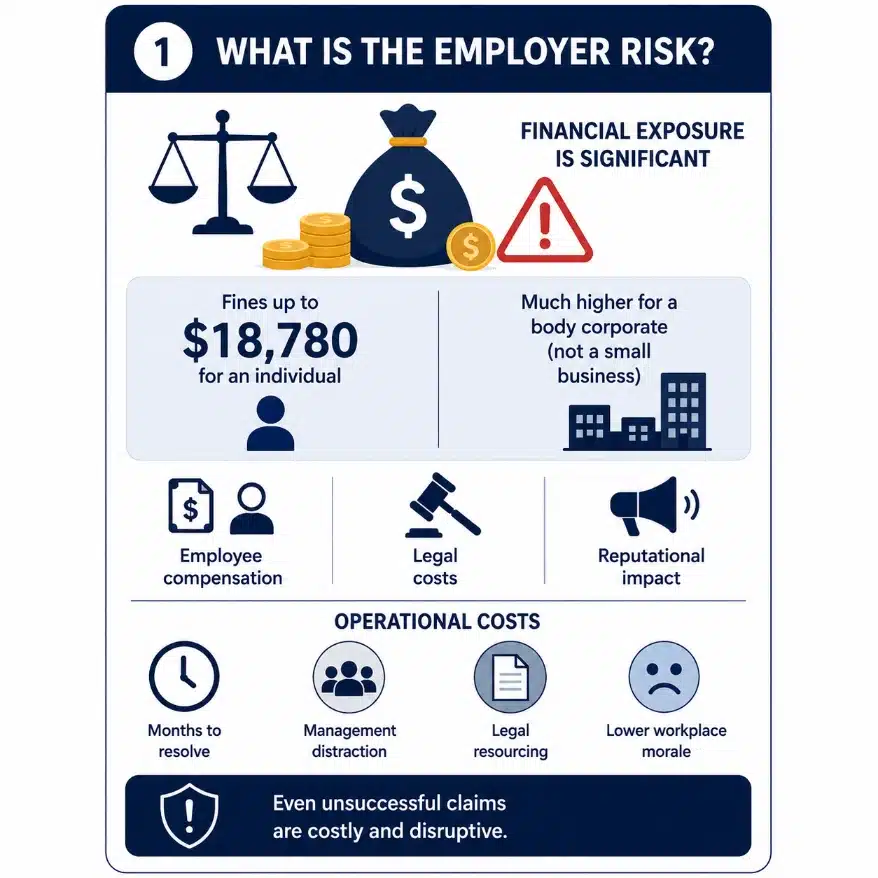
Beyond the direct financial penalty, there’s also the operational cost to consider.
Discrimination claims often take months to resolve, during which time management attention, legal resourcing, and workplace morale can all take a hit, regardless of the eventual outcome. Even claims that are ultimately unsuccessful can be expensive and disruptive to defend.
The Reverse Onus of Proof in Adverse Action
This is one of the most important, and most misunderstood, features of the general protections framework. In a typical legal dispute, the person making the claim has to prove their case. Under the Fair Work Act’s adverse action provisions, that’s reversed: once an employee shows that adverse action occurred and that a protected reason was in the mix, it’s the employer who has to prove the action wasn’t taken for that prohibited reason.
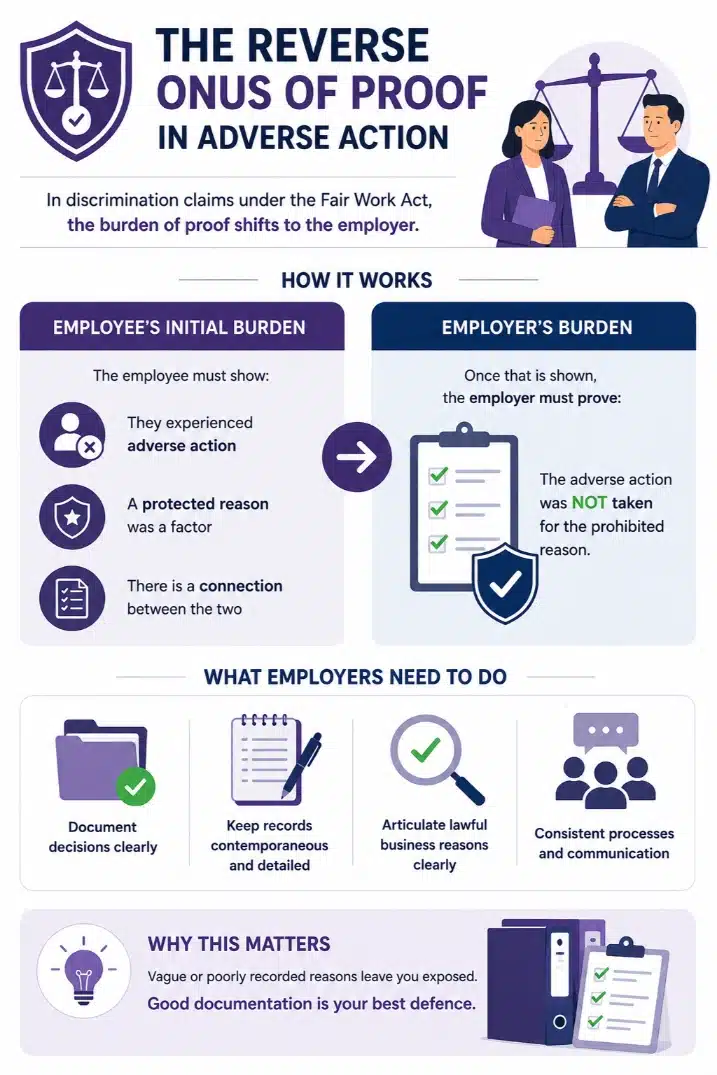
In practice, this means employers need to be able to clearly document and articulate the lawful reasons behind decisions like dismissals, demotions, or missed promotions. Vague or poorly recorded reasoning leaves a business badly exposed if a claim is lodged, simply because there is nothing solid to point to in your defence. This is one of the strongest practical arguments for good documentation habits, it’s your actual defence if a claim ever arises.
Vicarious Liability For Employee Conduct
Employers can also be held vicariously liable for discriminatory conduct or harassment carried out by their employees during the course of employment, even if the business itself never condoned or was aware of the behaviour. The main defence available is showing that the employer took reasonable steps to prevent the conduct from occurring, which again ties back to having active systems in place rather than just a policy that exists on paper.
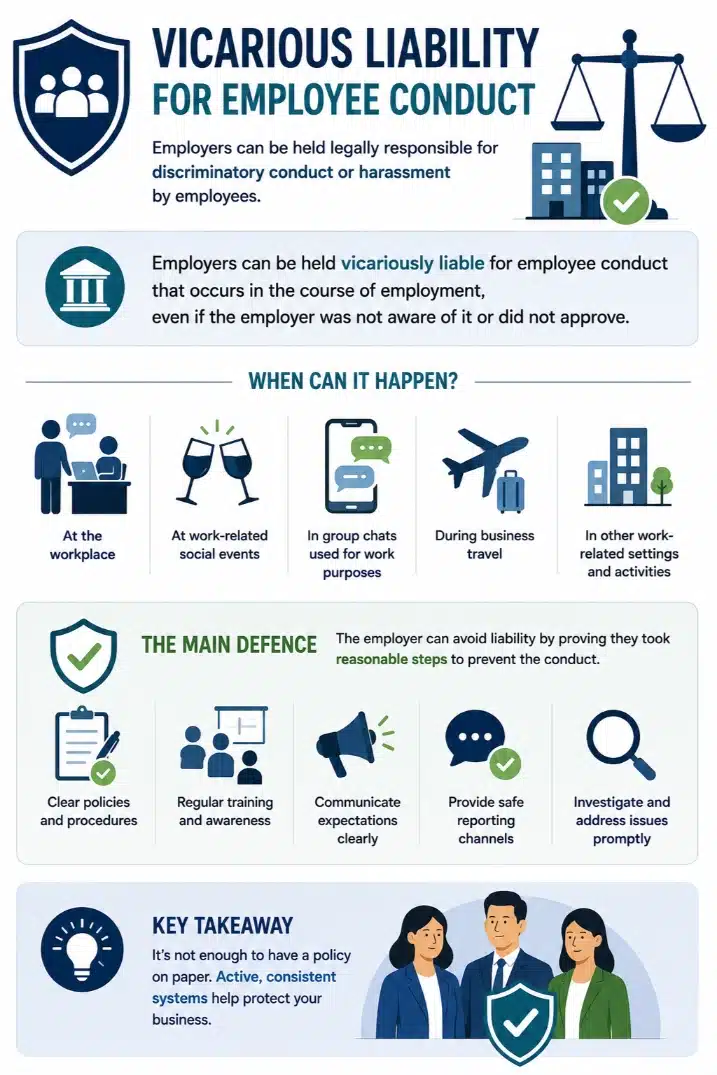
Vicarious liability can extend surprisingly far, covering conduct at work-related social events, in group chats used for work purposes, or during business travel, not just behaviour that happens strictly within office hours at the physical workplace.
When is Different Treatment Lawful?
Not every instance of different treatment amounts to unlawful workplace discrimination in Australia. There are recognised exceptions built into the law, including occupational requirements (for example, requiring a specific gender for particular roles in limited, legally recognised circumstances), special measures designed to achieve equality for a disadvantaged group, and reasonable adjustments made specifically to support an employee with a disability.
Reasonable management action also sits outside the scope of unlawful discrimination. Setting performance standards, giving honest feedback, or restructuring a role for business reasons isn’t discriminatory just because an employee affected by it happens to have a protected attribute, provided the action itself was taken for legitimate reasons and carried out fairly.
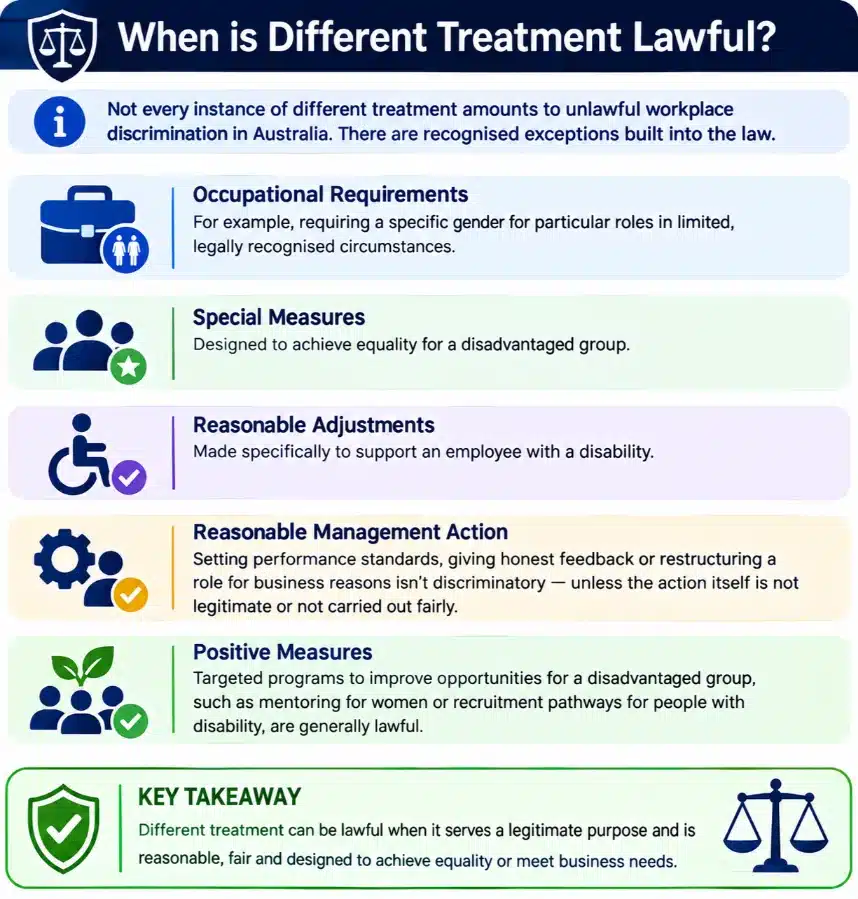
Positive measures designed to improve opportunities for a disadvantaged group, such as a targeted mentoring program for women in leadership, or a recruitment pathway for people with disability, are also generally lawful, since the law distinguishes between measures aimed at achieving substantive equality and measures that disadvantage people based on a protected attribute.
How Can Employers Comply and Reduce Discrimination Risk?
Getting workplace discrimination compliance right comes down to a handful of consistent practices, rather than one single fix:
• Build a clear, written anti-discrimination policy that names the protected attributes, sets out expected behaviour, and explains how complaints are handled.
• Review recruitment, promotion, and performance processes for anything that might unintentionally disadvantage a particular group.
• Train managers to recognise both direct and indirect discrimination, since the indirect kind is far easier to miss.
• Take every complaint seriously, investigate promptly, and keep clear, contemporaneous records throughout.
• Document the reasons behind employment decisions as you make them, not after the fact.
• Review policies and systems regularly, rather than treating compliance as something to set and forget.
When You Need Outside Help, Call HR Expertise
If you are not confident your current systems would hold up under scrutiny, that is exactly the kind of gap a specialist human resource consultancy can help close before it becomes a real problem.
For businesses without the internal capacity to manage this ongoing, our HR outsourcing solutions can take the policy work, training, and complaint handling off your plate entirely. And if a specific question comes up that needs a fast, referenced answer, our HR hotline services are built exactly for that.
Workplace discrimination compliance is an ongoing responsibility that touches almost every part of how a business manages its people, and getting it right protects both your team and your business.
Frequently Asked Questions
Can an employee bring a discrimination claim without being dismissed?
Yes. Discrimination claims can relate to any adverse treatment across the employment relationship, missed promotions, reduced hours, or unfair treatment while still employed can all form the basis of a claim, not just termination.
Does it matter if discrimination wasn’t intentional?
No, particularly for indirect discrimination, where intent is largely irrelevant. What matters is whether a rule or decision disadvantaged someone based on a protected attribute, and whether there was a reasonable justification for it.
How long do employees have to lodge a discrimination complaint?
Time limits vary depending on which law and which body the complaint is made to, so it’s worth getting specific advice rather than assuming a general timeframe applies.
Is a workplace policy enough to protect against a discrimination claim?
A policy helps, but it’s not a complete defence on its own. Employers also need to show the policy was actively communicated, that training was delivered, and that complaints were handled properly when they arose.

Cedric has 13+ years of demonstrated experience as a senior HR generalist with a broad commercial and project-driven background within leading global organisations across a range of industries. He is qualified with an MBA from the Australian Institute of Business (AIB), an Advanced Diploma of Management specialising in Human Resources and an HR Consulting – Business Partnering course from the Australian Human Resources Institute (AHRI).